SPARE-GS: Structural Parsimony and Resource Efficiency for 3D Gaussian Splatting

Zhang Chen1,5, Shuai Wan1, Fuzheng Yang2, Jiazhi Xia3, Weiyao Lin4, Junhui Hou5
1Northwestern Polytechnical University   2Xidian University   3Central South University   4Shanghai Jiao Tong University   5City University of Hong Kong
SPARE-GS Overview

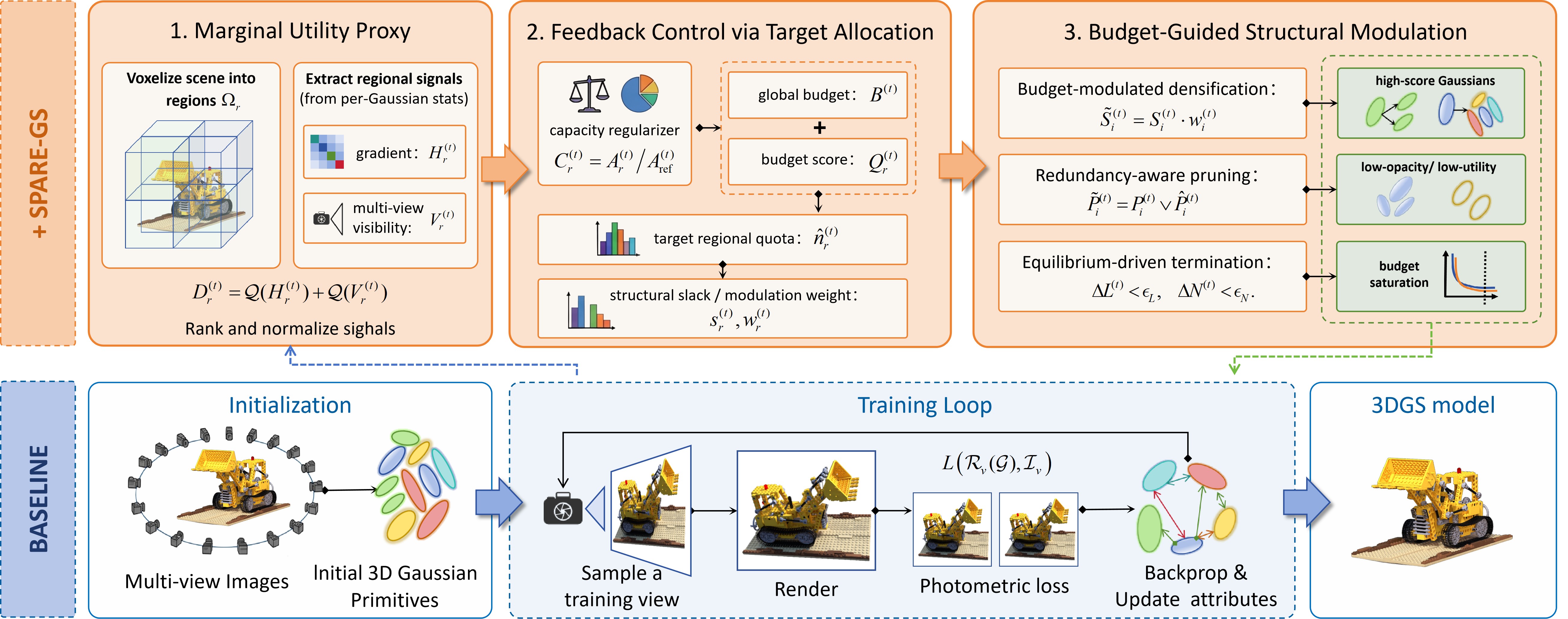
Overview of the SPARE-GS framework. To achieve global budgeted-constrained optimization, our method establishes a Marginal Utility Proxy via scene voxelization. We utilize Feedback Control via Target Allocation to dynamically compute regional quotas, and apply Budget-Guided Structural Modulation to guide densification, redundancy pruning, and termination. The standard pipeline is controlled and evaluated by our proposed modules.

Abstract

3D Gaussian Splatting (3DGS) achieves high-fidelity novel view synthesis in real-time; however its training efficiency and representation compactness are hindered by excessive primitive proliferation. To address this challenge, we formulate the structural evolution of 3DGS as a global budget-constrained optimization problem and derive an optimality condition, which requires the marginal utility of structural resources to be balanced across spatial regions under a finite primitive budget. Based on this formulation, we propose SPARE-GS, a general plug-and-play framework that dynamically aligns the distribution of 3D Gaussian primitives with regional representational demand.

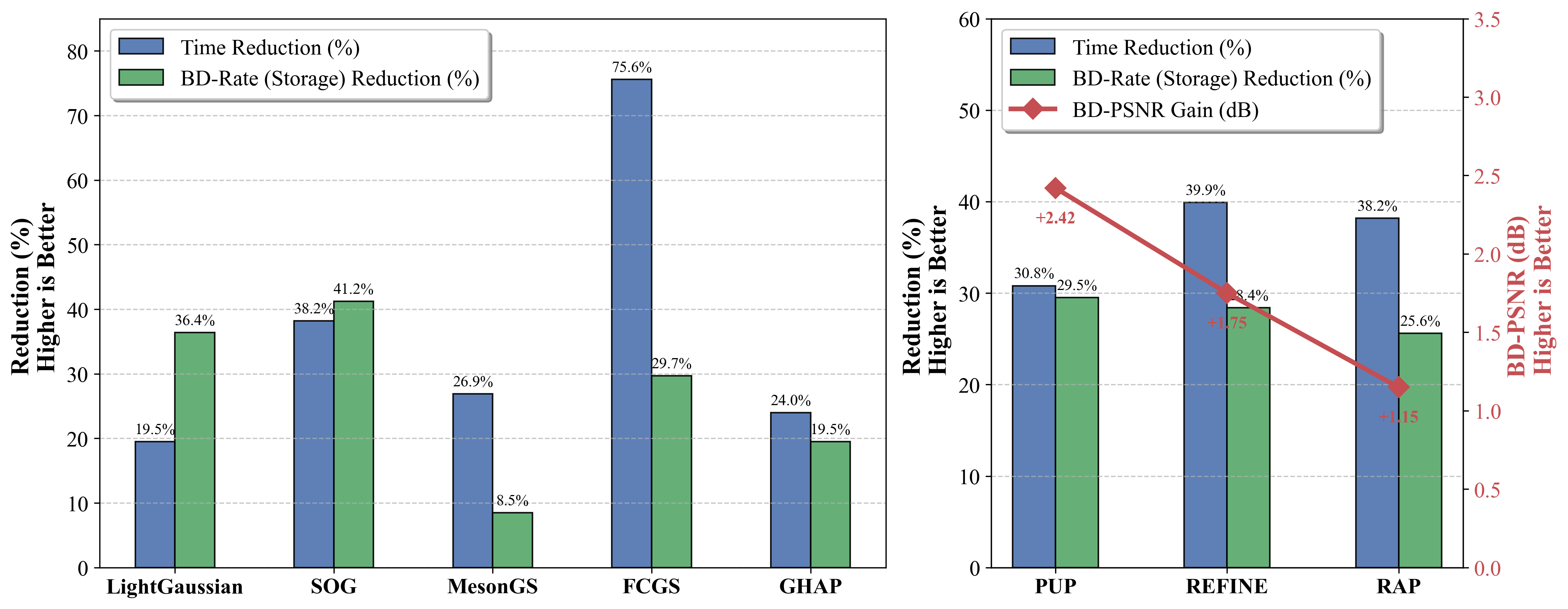
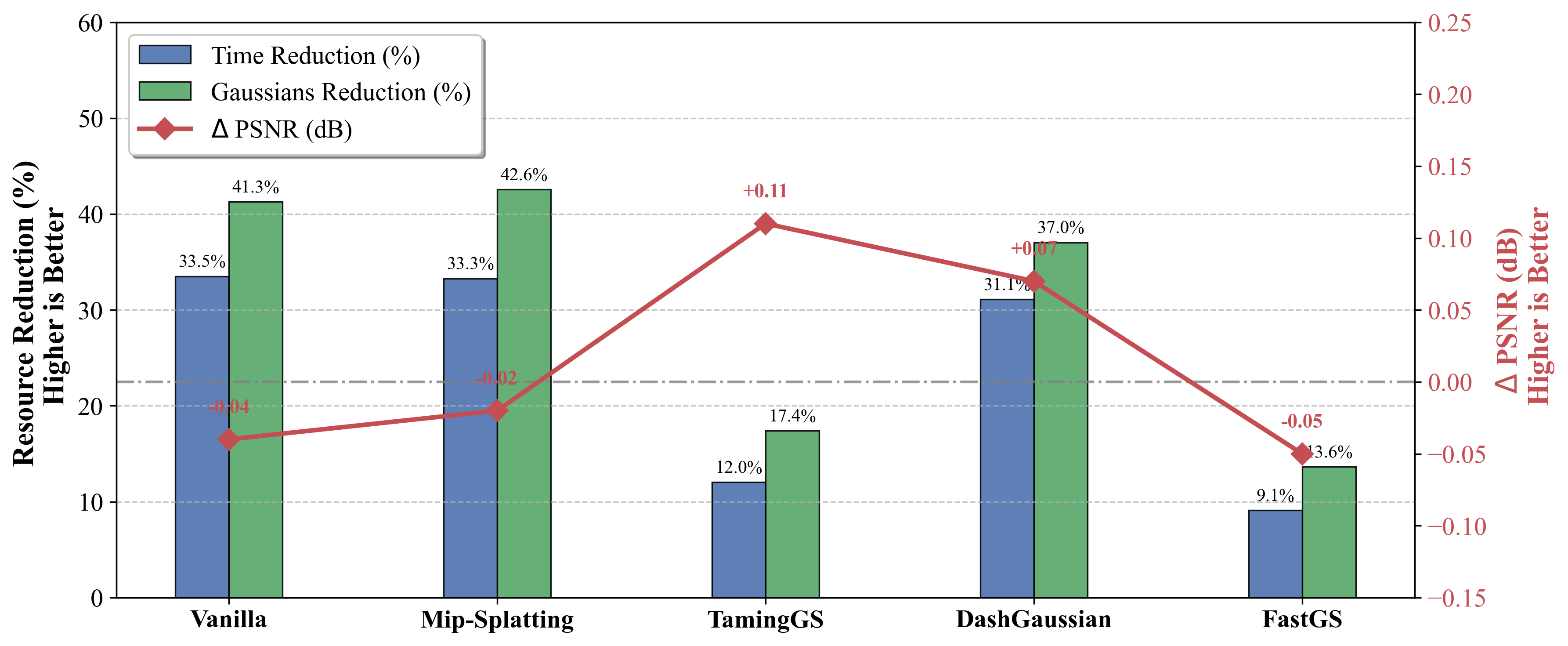
SPARE-GS estimates capacity-normalized regional demand, assigns adaptive target quotas, and uses regional budget deviations to coordinate densification, pruning and adaptive termination toward a more balanced structural allocation. Extensive experiments across standard, accelerated, and structure-enhanced 3DGS pipelines demonstrate that SPARE-GS reduces the Gaussian count and training time by an average of 30.38% and 23.81%, respectively, while improving the average PSNR. Moreover, the resulting compact representations reduce downstream processing time and improve the rate-distortion performance of diverse compression and pruning methods, demonstrating the broad applicability of global structural budget regulation.
Training Gains
(a) Efficiency and Quality Gains during 3DGS Training
Post-processing Benefits
(b) Benefits on Post-processing Compression & Pruning

Performance gains of incorporating SPARE-GS. (a) Training: across diverse 3DGS pipelines, SPARE-GS reduces training time and Gaussian counts without sacrificing rendering quality. (b) Post-Processing: this compact representation benefits downstream tasks, delivering substantial storage and latency savings for various compression and pruning frameworks.

Visual Comparison (Plug-and-Play)

BibTeX

@article{chen2026sparegs,
  author    = {Zhang Chen and Shuai Wan and Fuzheng Yang and Jiazhi Xia and Weiyao Lin and Junhui Hou},
  title     = {SPARE-GS: Structural Parsimony and Resource Efficiency for 3D Gaussian Splatting},
  year      = {2026},
}